A strong article can be useful, original, and well optimised, yet still receive very few visits if the headline fails to earn attention. Readers usually see the title before they see the introduction, examples, or conclusion. That makes the headline a promise: it tells people what they will gain, why the topic matters, and whether the page is worth their time.
Learning how to write catchy headlines is not about adding exaggerated words or copying viral formulas. It is about understanding the reader’s intent, presenting a clear benefit, and creating enough curiosity to encourage an honest click. The best headlines attract the right audience and prepare them for the content that follows.
This guide explains the psychological triggers behind high-click-through-rate headlines, practical patterns you can reuse, and a simple process for writing and improving titles. The goal is not to trick people. It is to make the value of your article immediately visible.
Why Headlines Decide Whether Content Gets Read
Online readers make fast decisions. A headline competes with search results, social posts, emails, videos, notifications, and dozens of open tabs. People cannot examine every piece of content in detail, so they use the title as a shortcut. In a few seconds, they decide whether the topic feels relevant, useful, credible, and timely.
A good headline performs three jobs at once: it identifies the subject, communicates a benefit, and creates a reason to continue. A weak title often fails because it is too vague, too broad, or focused on the writer rather than the reader. Compare “Thoughts About Better Content” with “7 Content Editing Steps That Make Blog Posts Easier to Read.” The second title gives the reader a clearer outcome and a more concrete expectation.
The Psychology Behind High-CTR Headlines
High-performing headlines often use several psychological principles together. These triggers are effective because they reduce uncertainty and connect the topic to a real human motivation. They should be used honestly and supported by the article.
A clear benefit: People want to know what improves after they click. Benefits such as saving time, avoiding mistakes, learning a skill, or making a better decision are stronger than a generic description of the topic.
Specificity: Numbers, time frames, audiences, and defined outcomes make a headline feel more concrete. “Improve Your Blog” is broad; “9 On-Page SEO Fixes for New Blogs” creates a clearer expectation.
The curiosity gap: A headline can reveal enough to establish value while leaving one useful detail unanswered. The gap should be small and relevant, not a mysterious trick that hides the actual topic.
Loss aversion: People pay attention to mistakes, risks, and missed opportunities. Headlines such as “5 Headline Mistakes That Reduce Clicks” work because readers want to protect the results they already have.
Identity and relevance: Naming the audience helps the right person recognise that the content is for them. Phrases such as “for beginners,” “for small businesses,” or “for WordPress bloggers” create immediate relevance.
Ease and confidence: Words such as simple, practical, step-by-step, and beginner-friendly reduce perceived effort. They are effective only when the content genuinely makes the task easier.
How to Write Catchy Headlines Step by Step
1. Start with the Reader’s Search Intent
Before writing the headline, define what the reader wants to accomplish. Are they trying to learn a process, compare options, solve a problem, avoid a mistake, or find examples? The title should match that purpose. A tutorial query needs a practical promise, while a comparison query needs clear choices and evaluation criteria.
Review the language your audience uses and build the article around the question behind the keyword. Our SEO resources can support this research, but the final headline should still sound natural to a human reader.
2. Put the Main Topic in Plain Language
Do not make readers decode the subject. Include the core topic or focus keyword naturally, especially when the article is designed for search traffic. The exact phrase does not need to be forced into every title, but the reader should instantly understand what the page covers.
For this article, “how to write catchy headlines” is clearer than “the hidden science of irresistible words.” The second phrase can work as supporting language, but it does not identify the topic as directly.
3. Lead with the Outcome, Not the Process
Readers usually care more about the result than the activity. Instead of “A Guide to Headline Writing,” consider “How to Write Headlines That Attract the Right Clicks.” The process is still included, but the outcome gives people a stronger reason to read.
4. Add a Specific Detail
Specific details make a promise easier to understand. You can add a number, audience, time frame, format, platform, or problem. Useful details include “12 formulas,” “for beginners,” “in WordPress,” “without clickbait,” or “before publishing.”
5. Use Strong, Natural Verbs
Verbs create movement. Words such as write, improve, avoid, build, choose, increase, simplify, compare, and fix tell the reader what action or result is involved. Replace weak phrases such as “information about” with a direct action whenever it improves the sentence.
6. Create an Honest Curiosity Gap
Curiosity works best when the reader already understands the topic and benefit but wants to discover the method, example, or missing detail. “The One Headline Element Most Beginners Forget” is acceptable only if the article clearly identifies and explains that element.
7. Match the Headline to the Content
Every promise in the title must be fulfilled. If the headline says “15 examples,” provide 15 useful examples. If it promises a step-by-step process, organise the article into clear steps. If it says “fast,” explain what can reasonably happen quickly and what still takes time.
8. Write at Least 10 Variations
The first headline is usually a starting point, not the final choice. Write multiple versions that emphasise different angles: benefit, mistake, curiosity, speed, simplicity, audience, or proof. Then compare them for clarity, relevance, and credibility.
You can brainstorm manually or use ideas from AI tools, but treat generated titles as drafts. Check every claim, remove awkward wording, and adapt the tone to your audience.
9. Keep It Concise and Front-Load Important Words
A headline should be long enough to communicate value but short enough to scan quickly. Search engines may shorten title links depending on the device, so place the main topic and benefit early. Remove filler words that do not change the meaning.
10. Test Performance and Improve Over Time
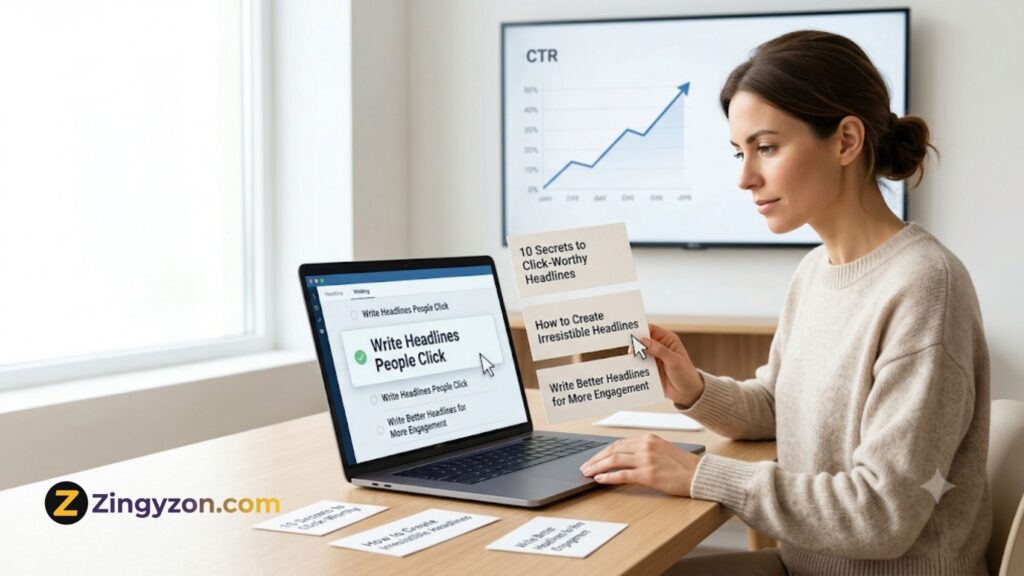
A headline is a hypothesis. After publishing, review impressions, clicks, click-through rate, ranking position, engagement, and the queries that display the page. Low clicks with reasonable visibility may suggest that the title is unclear, unappealing, or poorly matched to search intent. However, position, competition, brand recognition, and the search-result layout also affect CTR.
Change one major element at a time and record the date so you can evaluate the effect. Broader testing and promotion ideas are available in our digital marketing guides.
12 Catchy Headline Patterns You Can Reuse
Formulas reduce blank-page pressure, but they should not make every title sound identical. Adapt the wording to the topic, audience, and promise.
| Pattern | Example |
| How to [achieve result] without [common obstacle] | How to Write Catchy Headlines Without Using Clickbait |
| [Number] ways to [achieve result] | 11 Ways to Improve Blog Headlines Before Publishing |
| [Number] mistakes that [negative consequence] | 7 Headline Mistakes That Reduce Search Clicks |
| The beginner’s guide to [topic] | The Beginner’s Guide to Writing SEO-Friendly Titles |
| [Number] examples of [desired skill] | 15 Catchy Headline Examples for Blog Posts |
| Why [common approach] fails—and what to do instead | Why Vague Headlines Fail—and What to Write Instead |
| [Topic] checklist: [specific outcome] | Headline Checklist: 10 Questions to Ask Before Publishing |
| The simple [method] for [result] | The Simple Three-Part Formula for Clearer Headlines |
| [Number] proven principles behind [result] | 6 Psychological Principles Behind High-CTR Headlines |
| Before you [action], read this | Before You Publish a Blog Post, Check the Headline |
| [Option A] vs [Option B]: which is better? | Question Headlines vs List Headlines: Which Is Better? |
| What [audience] should know about [topic] | What New Bloggers Should Know About Headline Testing |
Common Headline Mistakes to Avoid
- Being too vague: the reader cannot identify the topic, benefit, or audience.
- Stuffing keywords: repeated phrases make the title unnatural and reduce trust.
- Making unsupported promises: words such as guaranteed, instant, and effortless often create expectations the article cannot meet.
- Using emotion without information: dramatic words cannot replace a clear subject and outcome.
- Copying competitors exactly: similar titles make your page difficult to distinguish and may not reflect your unique angle.
- Writing for clicks only: a title should attract readers who will genuinely benefit from the content.
- Forgetting mobile readers: important words placed at the end may be harder to notice when the title is shortened.
When publishing through WordPress, check that the on-page H1, SEO title, URL slug, and social-sharing title are intentional. They can be similar, but each should accurately represent the same article.
A Quick Headline Checklist Before You Publish
- Does the headline clearly identify the topic?
- Does it match the reader’s search intent?
- Is the main benefit or outcome visible?
- Have you added a useful specific detail?
- Is the wording natural rather than keyword-stuffed?
- Does every promise appear in the article?
- Can the title be understood in one quick scan?
- Are the most important words near the beginning?
- Is the emotional language credible for the topic?
- Did you compare at least five to ten alternatives?
Frequently Asked Questions
What makes a headline catchy?
A catchy headline combines relevance, clarity, a meaningful benefit, and a small amount of curiosity. It helps the right reader understand why the content deserves attention without hiding the topic or exaggerating the result.
Should the focus keyword appear in the headline?
Use the focus keyword when it fits naturally and helps clarify the topic. An exact match is not always necessary, but the title should contain language that readers recognise and use when searching for the subject.
Are number headlines always better?
Numbers can improve specificity and scanning, especially for lists, steps, examples, and mistakes. They are not automatically better than question, benefit, or how-to headlines. Choose the format that best matches the content.
How often should a published headline be changed?
Change a headline when you have enough performance data or a clear reason, such as poor alignment with search intent, outdated wording, or a stronger content angle. Avoid frequent random changes because they make results difficult to evaluate.
Conclusion
The art of headline writing is the ability to turn real value into a clear and compelling promise. Start with the reader’s intent, explain the outcome, add useful specificity, and create curiosity without becoming misleading. Then write several versions and choose the title that is easiest to understand and hardest to ignore for the right reasons.
A headline cannot rescue weak content, but weak wording can hide excellent content. Treat the title as an important part of the article rather than a final decoration. With practice, testing, and honest alignment between the promise and the page, your headlines can earn more qualified clicks and build stronger reader trust.