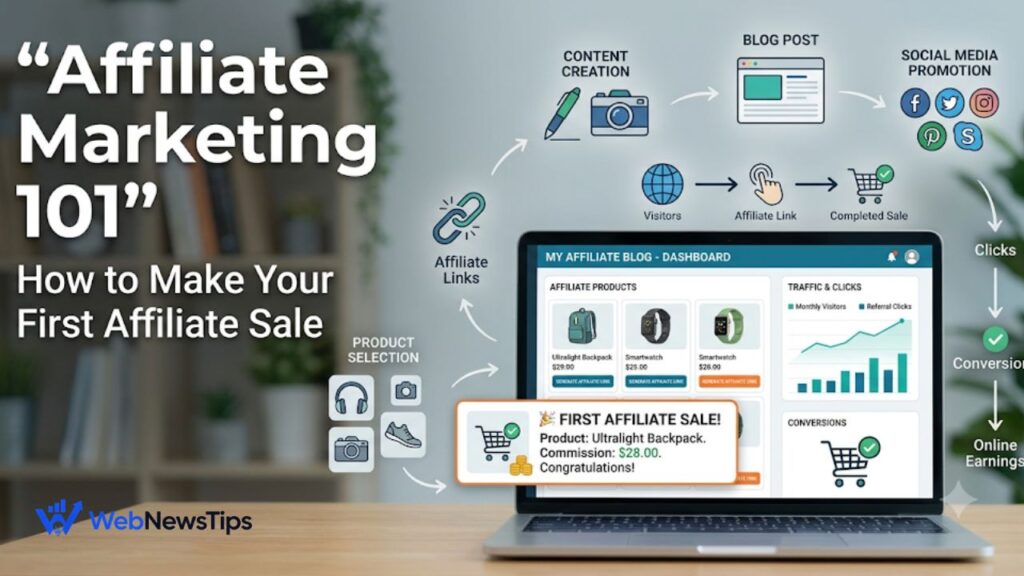
Affiliate marketing sounds simple: recommend a product, add a special link, and earn a commission when someone buys. The basic idea really is that straightforward. The difficult part is earning enough trust that a reader is willing to click your link and take action. Your first affiliate sale usually comes from solving one specific problem for one specific person, not from covering your website with banners.
If you are starting from zero, you do not need thousands of visitors or dozens of affiliate programs. You need a focused topic, a product that genuinely fits the reader’s need, useful content, a clear disclosure, and a sensible way to measure what people click. If you have not built your site yet, start with this beginner guide on how to start a blog, then return here to build your first monetization path.
What Is Affiliate Marketing?
Affiliate marketing is a performance-based arrangement. A company gives you a tracked link or referral code. You place that link inside useful content, an email, a comparison, or another approved channel. If a visitor completes the required action, such as making a purchase or starting a paid subscription, the affiliate program may credit you with a commission under its own terms.
The important word is recommendation. Good affiliate marketing is not simply link sharing. It works when your content helps a person decide what to buy, which option fits them, how a product works, or whether they should buy anything at all. That is why helpful content and affiliate income often grow together. A strong content marketing strategy can bring people in before they are ready to purchase and guide them toward a sensible decision.
Step 1: Choose a Narrow Problem Before Choosing Products
A common beginner mistake is joining several programs first and then trying to invent content around whatever pays a commission. Reverse the process. Start with a real audience problem. A home-office blog might help readers choose desk accessories for small spaces. A travel blog might focus on lightweight packing. A software blog might help freelancers choose invoicing or design tools.
Once the problem is clear, make a short list of products or services that directly help. This keeps your recommendations relevant and makes your content easier to trust. Before applying to any program, check its commission structure, payment rules, cookie or attribution terms, allowed promotional methods, geographic restrictions, and policies on brand bidding or email promotion. Program terms differ and can change, so the current official agreement should always win over old advice from a blog post or video.
A simple product-selection test
- Would I recommend this product even if the commission were lower?
- Does it solve the exact problem my article is about?
- Can I explain who should buy it and who should not?
- Is the merchant trustworthy enough that I am comfortable sending readers there?
- Can I create genuinely useful content around the product without forcing it?
If you cannot answer those questions comfortably, keep looking. Your first sale is useful, but protecting reader trust is worth far more than a single commission.
Step 2: Create Content for People Who Are Close to a Decision
Beginners often publish broad posts such as ’10 Best Gadgets’ and expect sales. Those articles can work, but they are competitive and often too vague. A better first target is a specific search with buying intent. Think ‘best budget microphone for Zoom calls in a small room’ instead of ‘best microphones.’ The narrower topic lets you answer the reader’s situation in more detail.
Useful affiliate content formats include product reviews, product-versus-product comparisons, ‘best for’ roundups, setup tutorials, troubleshooting guides, resource pages, and case-study style posts. The goal is not to praise everything. Mention limitations, price trade-offs, and the type of buyer who should skip the product. Readers notice when every product is described as perfect.
Use a simple decision structure
- State the reader problem clearly.
- Explain what matters when choosing a solution.
- Show one or more suitable options.
- Describe benefits using real use cases, not empty hype.
- Mention meaningful drawbacks or limitations.
- Give a clear recommendation for a specific type of buyer.
Step 3: Disclose the Affiliate Relationship Clearly
Disclosure is not a small footer detail. If you may earn money from a recommendation, readers should be able to understand that relationship without hunting for it. For audiences covered by U.S. rules, the Federal Trade Commission says material connections should be disclosed clearly and conspicuously. Its affiliate guidance also says the disclosure should be close to the recommendation or link, and wording should make the financial relationship understandable.
A plain disclosure can be as simple as: ‘This post contains affiliate links. I may earn a commission if you purchase through them, at no extra cost to you.’ Avoid relying only on vague labels that readers may not understand. WebNewsTips already has an Affiliate Disclosure page that can support a site-wide policy, but individual posts should still make the relationship obvious where needed.
Disclosure requirements vary by country, platform, and program, so treat this as a practical starting point rather than legal advice. Also follow the rules of the affiliate program you join.
Step 4: Place Affiliate Links Where They Help the Reader
High-converting links are usually contextual. They appear at the moment a reader is thinking, ‘That sounds right for me – where do I get it?’ A link placed immediately after a meaningful benefit, comparison, or recommendation has a reason to exist. A random link inserted every few sentences feels pushy and makes the page harder to read.
Good places for affiliate links
- After the first clear recommendation in a review.
- Inside a comparison table when the reader can see the differences.
- After a section explaining why a product fits a specific use case.
- Near a natural call to action such as checking current pricing or features.
- At the end of a detailed review for readers who finished the evaluation.
Use descriptive anchor text instead of generic phrases such as ‘click here.’ For example, ‘check the current plan and features’ tells the reader what will happen. Buttons can work well for a primary action, but text links are useful inside the explanation. On mobile, make sure buttons are easy to tap and do not interrupt the reading experience.
Step 5: Send the Right Traffic, Not Just More Traffic
One hundred visitors who are comparing solutions can be more valuable than ten thousand casual visitors. Search traffic works well for affiliate content because people often search when they have a problem or a buying question. Social media can introduce your content to new readers, while an email list helps you stay in touch with people who are not ready to buy today.
Do not build your entire plan around one traffic source. Search rankings move, social platforms change reach, and affiliate programs can change terms. Over time, build a small email audience you can reach directly. This email marketing guide for beginners explains how to start that owned audience without making the process complicated.
If social media is part of your plan, share the useful idea first and the affiliate offer second. A tutorial, checklist, before-and-after explanation, or short comparison gives people a reason to care. These social media marketing tips can help you promote content without turning every post into an advertisement.
Step 6: Track Clicks and Learn From What Readers Do
Your first affiliate sale teaches you something, but the clicks before that sale teach you even more. Track which articles receive traffic, which affiliate links get clicked, which pages keep visitors engaged, and which topics produce no action. That information tells you where to improve instead of guessing.
Google Analytics 4 can measure outbound link clicks when enhanced measurement is enabled. That makes it useful for seeing which links send visitors from your site to merchant websites. Your affiliate dashboard remains the source for credited sales and commissions, while analytics helps you understand on-site behavior. If GA4 feels confusing, use this Google Analytics 4 guide for beginners to understand traffic, events, and reporting.
A simple beginner tracking sheet
- Article URL and target keyword
- Monthly organic or referral traffic
- Affiliate link clicks
- Sales or leads credited by the program
- Estimated click-to-sale conversion rate
- Notes about what you changed and when
Do not panic over a tiny data sample. Ten clicks without a sale does not prove an offer is bad. Look for patterns over time. If a post gets traffic but almost nobody clicks, the problem may be the recommendation, link placement, or mismatch between search intent and product. If people click but sales stay at zero for a meaningful sample, the merchant page, pricing, audience fit, or attribution rules may deserve a closer look.
How to Increase Your Chances of the First Sale
The fastest improvement usually comes from making one strong page better rather than publishing twenty weak pages. Re-read the article as a buyer. Does the introduction confirm the exact problem? Is the recommendation visible without scrolling through unnecessary filler? Are the benefits specific? Have you explained the main drawback? Is the affiliate disclosure easy to notice? Does the page load cleanly on a phone?
Then strengthen the page with proof you can honestly provide: original screenshots, your own photos, a short demonstration, pricing context, a comparison table, or a real example of how the product solves the problem. Never invent personal experience, test results, or earnings. Trust is difficult to build and very easy to lose.
Common Affiliate Marketing Mistakes Beginners Should Avoid
- Promoting too many unrelated products instead of building topical trust.
- Writing only for commissions and ignoring the reader’s actual question.
- Hiding disclosures or assuming a footer disclosure is always enough.
- Stuffing affiliate links into every paragraph.
- Copying merchant descriptions instead of adding useful analysis.
- Ignoring mobile layout, page speed, and broken links.
- Judging a strategy after a handful of clicks.
- Depending on one merchant, one platform, or one traffic source forever.
A 30-Day Plan to Work Toward Your First Affiliate Sale
In week one, choose one narrow niche problem and shortlist three to five relevant products or services. Read the program rules before applying. In week two, publish one high-intent article such as a detailed comparison, review, or problem-solving tutorial. Add a clear affiliate disclosure and only a few purposeful links.
In week three, publish two supporting articles that answer earlier-stage questions and internally link them to the main money page. Improve the title, introduction, images, and mobile experience. In week four, promote the helpful content through channels you already use, start collecting email subscribers if appropriate, and review analytics and affiliate clicks. Make one or two evidence-based improvements instead of changing everything at once.
The point of the 30-day plan is not to promise a sale by day 30. No honest guide can guarantee that. It gives you a repeatable system: find a real problem, publish useful content, recommend responsibly, track behavior, and improve the page. That system is what can eventually produce consistent affiliate revenue.
Frequently Asked Questions
How many visitors do I need for my first affiliate sale?
There is no fixed traffic number. A small number of highly targeted visitors can convert better than a large amount of general traffic. Focus first on matching the searcher’s problem with the right content and offer.
Do I need to buy every product I recommend?
Not always, but you must be truthful about your experience. If you have not personally used a product, do not write as if you have. You can still create useful research-based comparisons when you clearly explain your basis for the recommendation and avoid unsupported claims.
Where should I put my affiliate disclosure?
Place it where readers will notice it before or near affiliate recommendations and links. For U.S.-focused content, FTC guidance emphasizes clear and conspicuous disclosure and says closer to the recommendation is better.
Should beginners use paid ads for affiliate marketing?
Usually not as a first step. Paid traffic can burn money quickly, and many programs have specific advertising rules. Beginners are often better served by learning content, search intent, link placement, and conversion basics before paying for traffic.
Final Thoughts
The best affiliate marketing tips for beginners are not tricks. Pick a problem you understand, recommend products that truly fit, create content that helps readers make a decision, disclose the financial relationship clearly, place links where they are useful, and track what happens next. Your first sale may come from a small article that answers one question exceptionally well. Once that happens, study why it worked and repeat the process with the same care.